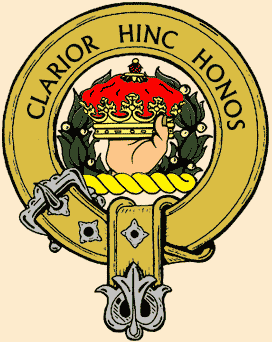
Clan Buchanan
"Clarior Hinc Honos"
Hence the brighter honour
"Clarior Hinc Honos"
Hence the brighter honour
The Buchanan name has been grounded in the lands surrounding the shores of Loch Lomond since 1225, when a grant by the Earls of Lennox to Sir Absalon of Buchanan, referred to in contemporaneous sources as 'clericus meus' i.e., he was a clergyman.
The derivation of the name in Gaelic lends validity to such a claim: 'Buth chanain' is Gaelic for the 'House of the Canon', an indication that the first Buchanans may have been a family dedicated to the service of the ancient Celtic church, or may have had a pre-charter, hereditary clerical tenure.
The clan can trace its origins back to Anselan O Kyan, son of a King of Ulster who landed in Argyll circa 1016. For his services against the Danes, he received the lands of Buchanan, lying to the east of Loch Lomond.
Equally, it has been argued that the benefactor was Gilbert, seneschal to the Earl of Lennox, and that the lands were in Stirlingshire. 1282 was when these lands were confirmed with baronial rights through a charter to Morris of Buchanan, who also held a small island called Clarinch, that subsequently became the clan battle cry.
The Buchanans supported the Bruce in the war of independence, thus assuring the predominance of the family in the post-Bannockburn era.
The Buchanan shield is virtually indistinguishable from the Royal Arms of Scotland, with a significant difference. The Buchanan version changes the lion and the double treasure of fleur de lis from red to black, thought to be an allusion to the marriage of Sir Walter Buchanan to the only daughter of Murdoch, Duke of Albany and Regent of Scotland. The regent was beheaded by his cousin, James I in 1425, and it is reputed the colouring reflects mourning for this loss of status.
Other descendants of this chiefly family were the Buchanans of Arnprior who held lands in Kippen, Perthshire, where they were known as 'Kings of Kippen'.
This popular nickname relates to a Walter Scott story in which King James V arrived at Arnprior disguised. He was met with poor hospitality—the Laird was eating and could not be disturbed. The disguised King asked the doorman to tell the 'King of Kippen' that "the Goodman of Ballengreich is come to feast". Buchanan knew these words signalled he was in the presence of true royalty, and begged forgiveness.
In 1884, James Buchanan founded his own whisky company in London. Recognizing a gap for a lighter Scotch, he created a blend that secured an exclusive contract to supply the British House of Commons, originally sold as "Buchanan's Blend."
Packaged in a black bottle with a simple white label, customers simply asked for "that black and white whisky." In 1902, Buchanan officially renamed it Black & White. He later introduced the iconic black Scottish Terrier and white West Highland White Terrier as the brand's mascots—a motif that remains world-famous today. James was a proud member of the clan's Leny cadet line and was later elevated to the peerage as Baron Woolavington.
The Buchanan name arrived in New Zealand with the first organized settlers in 1848. John Buchanan, a hand-loom weaver from Kirkintilloch, arrived in Dunedin on the Philip Laing, one of the two founding ships of the Otago settlement.
The clan has since produced notable figures across the country, from the pioneering botanist John Buchanan (1819–1898) to Sir Walter Clarke Buchanan, a key political leader in the Wairarapa. In the Manawatū, the family legacy flourished through Hedley Buchanan (1911–1991), a master rose grower and Life Member of the Palmerston North Rose Society. His expertise helped establish the world-renowned Dugald MacKenzie Rose Garden, cementing Palmerston North's reputation as the "Rose City."
From the lush hills of Stirlingshire to the pioneering landscapes of Aotearoa, the clan has left an indelible mark on New Zealand's agriculture, science, and community history.
The Buchanan tartan is renowned for its bold, asymmetrical pattern and vibrant hues. The modern colors reflect both the heritage of the clan and the dramatic landscape of our ancestral lands around Loch Lomond and Stirlingshire.